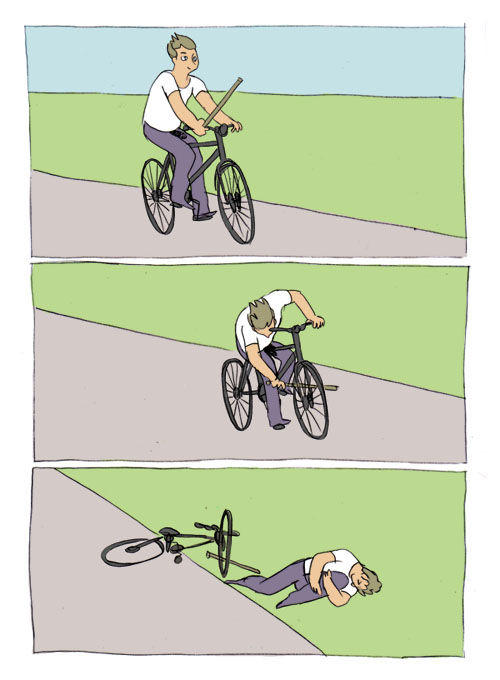
Welcome (back) to Macintosh
For at least 10 years, every Time Machine set up I have been in charge of, or tasked with maintaining for someone else, has eventually run into an issue where it stops backing up successfully. The only solution has been to start over, to not inherit backup state and to manually delete the old backup. My experience while looking up this solution repeatedly has been that this is not uncommon, and definitely is not just me holding it wrong; indeed the steps are marked as recommended solutions on Apple's own forums.
For several years, Spotlight's tag index has been unreliable. Querying for a file type and a tag often returns only a subset of the most recent files with the tags. Rebuilding the entire Spotlight index does nothing to alleviate this. The only cure is to relaunch the Finder, which sometimes fixes it. (There's also, 13 years after its introduction, no good, supported and documented command line interface or API to enumerate, add or remove tags (aside from those assuming that they are just the seven colors of labels). Just saying.)
For a few months, Finder has been having trouble with some Spotlight queries sometimes. When it happens, either they seemingly kick off and just hang forever, or they show results and then as you try to do something, Finder hangs (maybe as a result of a race condition during an update of the result). The only cure is to relaunch the Finder. Rebuilding the entire Spotlight index does nothing to alleviate this.
For several years, Finder has been having trouble keeping windows up to date with folder changes. Most commonly seen when a program I'm coding in my day-to-day work writes files to a folder, those files often don't show up at all. Sometimes you can force it to reload by backing out of the folder, using Go To Folder, entering the full path, leaving it for a few seconds and letting the go to panel "autocomplete" the name - for some reason, that seems to clear out the cobwebs momentarily and sync with the current state of the file system. Sometimes, even that workaround doesn't work, and the only cure is to relaunch the Finder. Leaving the entire computer to be for hours on end, then closing all windows, then opening a new window showing the same folder still does not refresh the state of the folder. Creating a new folder in the Finder in the affected folder, that new folder does appear, but things that did not originate from within the Finder - no.
For a year or so, listening to something with AirPods Pro and then opening Quick Look in the Finder to see a video with an audio track often glitches out the audio after a second or two. The mixed audio is fine before and after, but there is a very unpleasant glitch. No firmware or OS upgrade has resolved the issue.
For several years, switching to a window in a full screen space often does not necessarily focus the window. If you cmd+tab to a window that has its own full screen space, you can see that the window does not activate, and that hitting a keyboard shortcut that is intended to be valid just gives you a beep. You have to manually click in the window to activate it. This especially affects Safari in full screen windows with video, where hitting space to pause or left/right to scan is no longer effective.
With the possible exception of individual dodgy Time Machine protocol implementations from third parties, all of the issues are directly traceable to components fully in Apple's control. None of these issues are impossible for Apple to fix. All of them are incumbent on them to do so. Nearly all of them have persisted for at least two major OS releases and multiple Macs.
In the middle of all this, what Apple chooses to focus on is to implement a redesign that no one asked for, that butchers both the most conceivably fundamental usability and the visual pleasantness its user base has self-selected its platforms for; which only saving grace is that it is half-assed enough to not actually really change some things too badly, compared to what it could have been like. Although, had I upgraded to macOS Tahoe, chances are on top of the visual change, I would have been treated to basic Apple Event infrastructure falling apart and stopping working causing hangs, instability and unpredictability.
I have a MacBook Pro M1 Max from 2021, and because it is an excellent piece of hardware that still performs its function admirably, I have been holding on. The current state of macOS Tahoe is abysmal - I know because I listen to people who are long-time Mac users, who say so. If it was more stable, maybe I would do what I did with the last few upgrades, all of which made non-productive tweaks to the user interface in the interest of unity across platforms, and just upgrade. As it stands now, there's no chance.
The hardware is great and no doubt M5 and M6 variants will run circles around M1, but if I have to sink down further into this bog, that price is too high to pay - a common enough sentiment that it is a matter of public interest to document downgradability or attempting to block dark pattern upgrades. (And lest you think this is just Mac-related, the disease has spread at least to the wrist, but I am scoping it down somewhat for clarity.)
At some point, enough has to be enough. Apparently, the upcoming versions are going to be bug fix/improvement focused releases in the vein of the legendary Snow Leopard release (which itself was not uncontroversial at the time of its release for the number of things it removed). But with things having gotten this bad over so many years, my question is: does Apple even have the organizational acuity to understand, value and focus on these problems?
Clearly, if not breaking developers and users was a priority, we would not have been where we are today, or would we? Even ignoring bugs and design changes, in which way does it serve users to phase out Rosetta 2, which in a container-heavy world is more or less required for developers due to the ecosystem of ARM64 Linux containers being nowhere near as widespread as for AMD x86-64 ones, and which keeps many applications runnable that otherwise wouldn't be?
My hope is that there are Mac lovers within Apple who bite their tongue at every silly icon redesign, title bar-shrinking design reorganization, misty shower window—re-skin—love letter that they are forced to enact instead of taking what was once (and partially still is) that rarest of jewels, a long-term, continuously updated, well-designed user interface and mass market operating system and iterating on it to make it better. That there are people who, in so many words, bleed six colors; who have found not just a sterile tool, but a culture and a community. And who, like so many others in so many other situations, recently had to see what they love, what they value, what shaped them, torn apart by shifting, switching or recently starkly exposed priorities of people above them who either don't know what they have, or are happy to use it as a vehicle and ride it to places they care more about.
My hope is that Macintosh is not just one of these empires that was at the height of its power and then disintegrated because of warring factions, satiated and uncurious rulers, and droughts for which no one was prepared, ruining crops no one realized were essential for survival.
My hope is that there remains a primordial spark, a glimpse of genius, to rediscover, to reconnect to - to serve not annual trends or constant phonification, but the needs of the user to use the computer as a tool to get something done.
My hope is that, just as Apple crawled out of a hardware nightmare pockmarked by thermal throttling, keyboards incapacitated by strands of human hair and lack of respect for its users needs, it can choose to refocus its software and its humility too, and stop doing this to the bicycle for the mind.